
Simple Interest Calculator: Use I = Prt Correctly
Use I = Prt to calculate simple interest. Convert months and days to years, work an $8,000 example, and see when compounding is the wrong model to use.
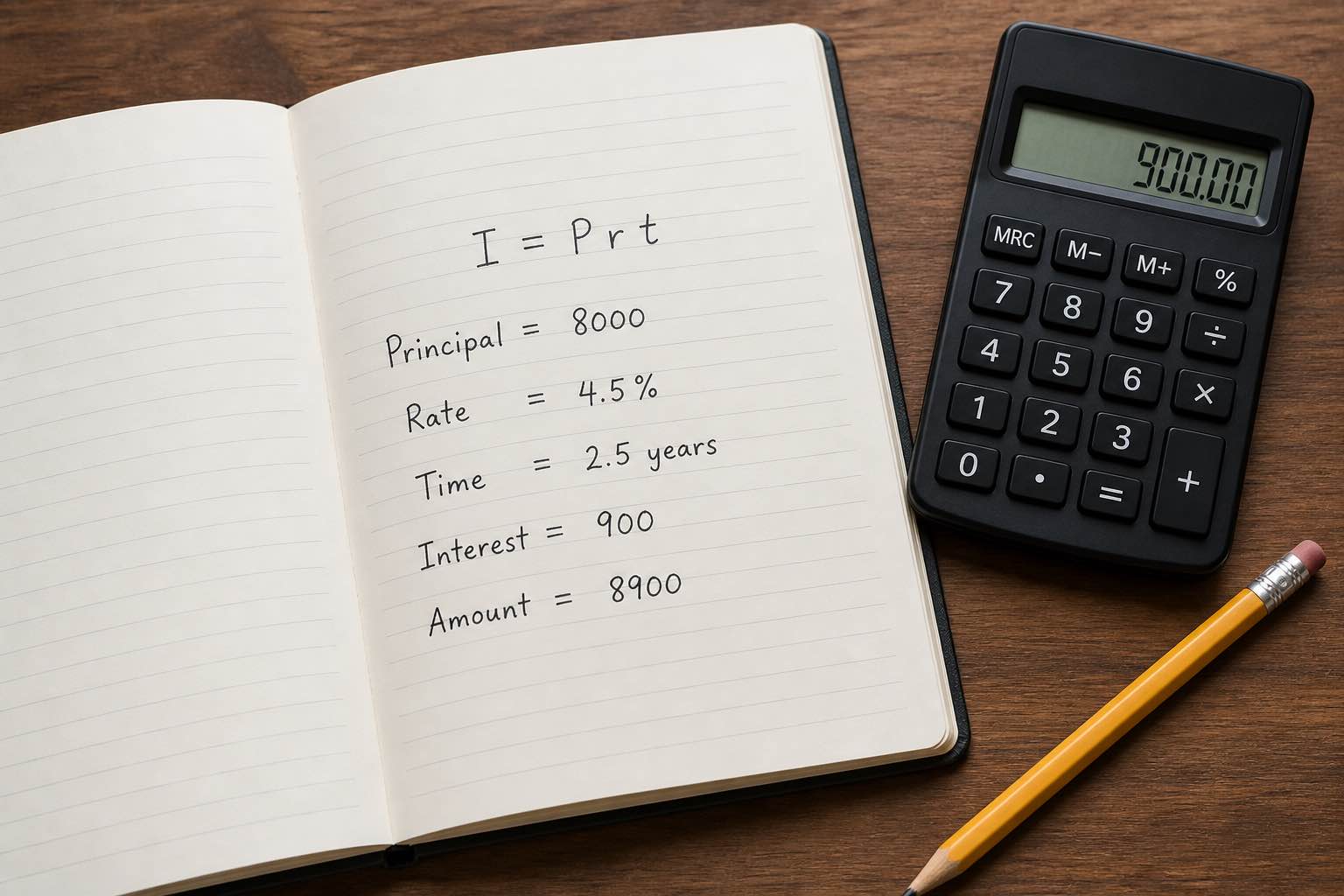
Simple interest is principal times annual rate times time in years. On Yaya Tools, the simple interest calculator uses that product and converts months and days into years before it multiplies. The result is interest earned or charged only on the original principal, plus a maturity amount equal to principal plus interest. It is not a compound-growth projection.
We checked the page default on August 27, 2026: $8,000 at 4.5% for 2 years and 6 months produces $900 of interest and a $8,900 maturity amount. Those figures match 8,000 × 0.045 × 2.5.
The I = Prt formula
OpenStax Prealgebra 2e defines simple interest as I = Prt, where P is principal, r is the annual rate as a decimal, and t is time in years. [1] The Yaya Tools page uses the same product. Type the rate as a percent (4.5 for 4.5%). The script divides by 100.
Maturity amount on the page is:
Amount = P + I = P × (1 + r × t)
Time is not always a whole number of years. The calculator converts mixed units with:
t = years + months ÷ 12 + days ÷ D
D is 365 or 360 and applies only to the days field. Months always divide by 12. A six-month stub is half a year, not six years.
If you only need one year’s percent of a base, the percentage calculator is enough. Use the simple interest page when the term is longer or shorter than one year and you still want the rate applied only to the original principal.
A worked $8,000 example
The tool’s sample inputs are:
| Input | Value |
|---|---|
| Principal | 8,000 |
| Annual rate | 4.5% |
| Years | 2 |
| Months | 6 |
| Days | 0 |
t = 2 + 6/12 = 2.5
I = 8,000 × 0.045 × 2.5 = 900
Amount = 8,000 + 900 = 8,900
Each year adds $360 on this principal and rate. Two years add $720. Six months add $180. The dollar interest per year does not increase, because earned interest never joins the base.
Ninety days on the same principal and rate is a different t. With a 365-day year, t = 90/365 and interest is about $88.77. With a 360-day year, t = 90/360 = 0.25 and interest is $90.00. Pick the day-count named in the problem. The page will not guess a jurisdiction for you.
When simple interest is the wrong model
Investor.gov, a U.S. Securities and Exchange Commission site, describes compound interest as interest earned on principal and on interest already credited. [2] If a balance grows that way, I = Prt understates later-year dollar interest at a positive rate.
Use the compound interest calculator when interest is added to the balance or when you model end-of-period deposits. Use the loan calculator when you need a monthly installment, total interest, and a principal that declines. A walkthrough of level payment versus equal principal covers those installment formulas. The simple interest page has no compounding frequency, no contribution field, and no amortization.
This arithmetic also omits fees, taxes, and inflation. A $900 interest line is exact for the inputs above. It is not a quote from a lender or a guaranteed savings yield.
Does the calculator solve for rate or time?
No. It computes I and P + I from principal, annual rate, and term. If you already know interest and need the rate, rearrange r = I ÷ (P × t) after t is in years. That inverse is not a control on the page.
Are the numbers uploaded?
No. Principal, rate, and term stay in the browser. Closing the tab clears the form.
What to do next
Open the simple interest calculator, keep or edit the $8,000 sample, and confirm $900 before you trust a hand spreadsheet. If the product compounds, switch pages instead of forcing I = Prt onto a compound balance.