
Loan Calculator: Monthly Payment, Interest, and Two Methods
Estimate a fixed-rate loan's monthly payment and total interest, then compare level payment with equal principal on the same amount, rate, and full term.
A loan calculator is useful when the amount, fixed annual rate, and term are known from the start. The loan calculator estimates monthly payment, total interest, and total repayment under two methods: level payment and equal principal. The math stays in your browser. It is not a lender quote.
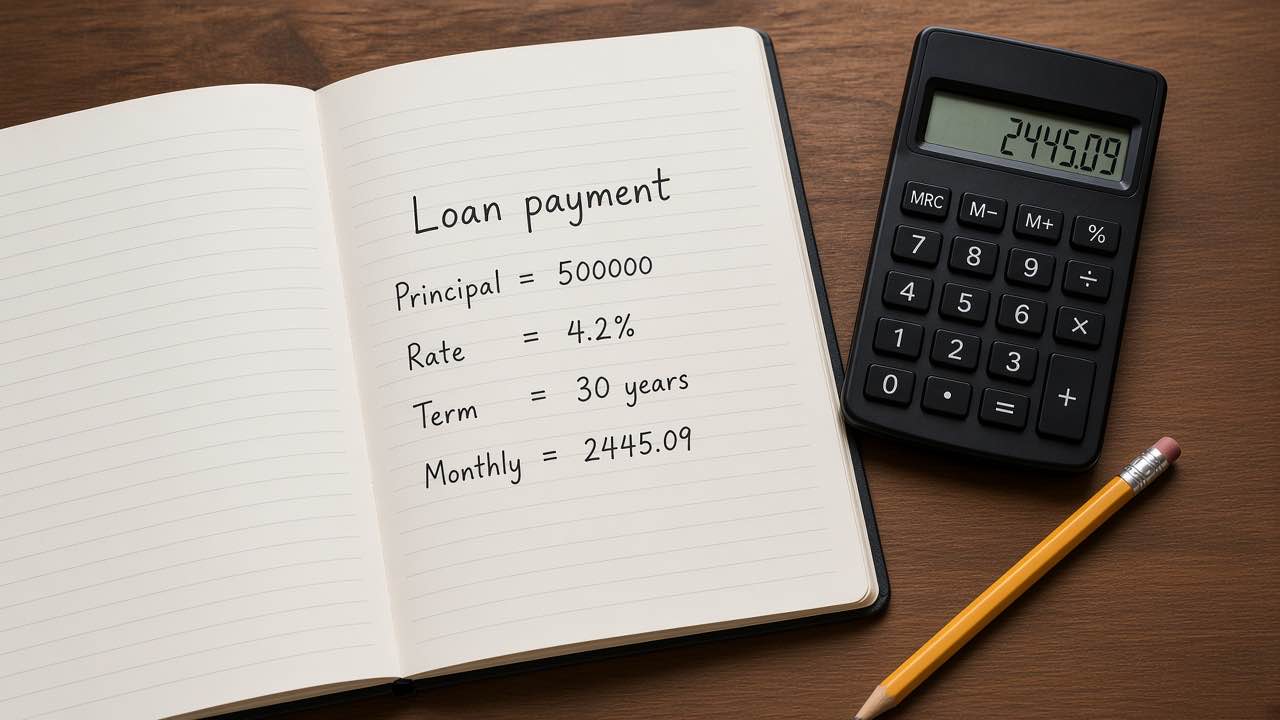
In 2026, we ran the page defaults on September 12: 500,000 at 4.2% for 30 years. Level payment produces a fixed installment of about 2,445.09 each month, 360 periods, about 380,230.91 of interest, and about 880,230.91 repaid. The display prefixes amounts with ¥; the arithmetic does not convert currencies, so keep every input in one unit.
Start with a whole number of months
Enter principal, annual rate as a percent (4.2 means 4.2 percent), and term in years. The script uses:
months = round(years × 12)
monthly rate = (annual rate ÷ 100) ÷ 12
The term must map to complete months. A horizon that cannot do that is rejected instead of inventing a partial period.
The Consumer Financial Protection Bureau explains that lenders use a standard formula so that, on a typical fixed-rate loan, scheduled principal-and-interest payments clear the balance at the end of the term. [1] Early payments are interest-heavy because the balance is still high; later payments send more to principal as that balance falls. [2]
This page estimates principal and interest only. A real mortgage payment can also include taxes, insurance, and mortgage insurance. [3]
Level payment versus equal principal
Level payment (annuity)
When the monthly rate is not zero:
payment = amount × r × (1 + r)^n ÷ ((1 + r)^n − 1)
total repaid = payment × n
At a zero rate, payment is simply amount ÷ months. Every installment is the same. That is the method most “monthly payment calculator” pages mean by a fixed-rate amortizing loan.
On the default inputs, r is 0.0035 and n is 360, which produces the 2,445.09 figure above.
Equal principal
monthly principal = amount ÷ n
first payment = monthly principal + amount × r
last payment  = monthly principal + monthly principal × r
total repaid  = amount + r × amount × (n + 1) ÷ 2
Default results for 500,000 at 4.2 percent over 30 years:
| Method | Featured payment | Total interest | Total repaid |
|---|---|---|---|
| Level payment | 2,445.09 each month | 380,230.91 | 880,230.91 |
| Equal principal | 3,138.89 first month | 315,875.00 | 815,875.00 |
The same 500,000 at 4.2 percent for 30 years starts at about 3,138.89 in month one and falls to 1,393.75 in month 360. Total interest is 315,875, which is lower than the level-payment interest on these inputs because more principal is repaid earlier. The first payment is also higher, so the cheaper interest cost is not free cash-flow.
Interest on the page is always total repaid − principal for either method.
When this page is the wrong tool
Use the simple interest calculator when interest is charged only on the original principal and there is no monthly amortization. Use the debt payoff calculator when you already owe a balance and want to test a payment you can make, or a date you want to finish. Use the compound interest calculator to model savings growth, not a declining loan.
The percentage calculator can show how much one payment differs from another. It cannot build an amortization schedule.
Lender numbers can differ because of daily interest, fees, origination costs, escrow, variable rates, prepayment, and rounding. The CFPB’s $100,000 example at 4% for 30 years is listed as $477 per month; the same formula here produces about $477.42 before they rounded. (CFPB monthly payment explainer) Treat the page as a scenario check, not a closing disclosure.
Does equal principal always cost less interest?
On the same amount, fixed rate, and term, yes in this model, because principal falls faster. The first months cost more cash. A lender may not offer this method.
Why would my bank’s payment be higher?
Taxes, insurance, mortgage insurance, fees, a different day-count, or a rate that is not fixed for the full term. This tool does not add those lines.
Are the numbers uploaded?
No. Amount, rate, term, and method stay in the browser. See the site privacy policy.
What to do next
Open the loan calculator, keep or edit the 500,000 sample, and confirm the level-payment installment near 2,445.09. Switch to equal principal and compare first-month cash with total interest. If you are trying to clear a card or other existing balance instead of sizing a new installment loan, switch to the debt payoff calculator.
This page is educational. Disclosure: it is not personalized financial, tax, or lending advice.
References
- CFPB: How do mortgage lenders calculate monthly payments? — source: https://www.consumerfinance.gov/ask-cfpb/how-do-mortgage-lenders-calculate-monthly-payments-en-1965/
- CFPB: How does paying down a mortgage work? — source: https://www.consumerfinance.gov/ask-cfpb/how-does-paying-down-a-mortgage-work-en-1943/
- CFPB: Principal-and-interest versus total monthly payment — source: https://www.consumerfinance.gov/ask-cfpb/on-a-mortgage-whats-the-difference-between-my-principal-and-interest-payment-and-my-total-monthly-payment-en-1941/