
Fraction Calculator: Add, Simplify, and Convert Decimals
Add mixed numbers, simplify with a GCD, and convert a finite decimal to a fraction. We ran the live page defaults on 10 Oct 2026: 2/3 plus 1 1/4 is 23/12.
A fraction calculator adds, subtracts, multiplies, or divides two rational numbers, then writes the answer in lowest terms. That is the whole job. The fraction calculator on Yaya Tools also simplifies a single fraction and turns a finite decimal into an exact reduced fraction. Mixed numbers are allowed. Type the whole part, the numerator, and the denominator in separate boxes.
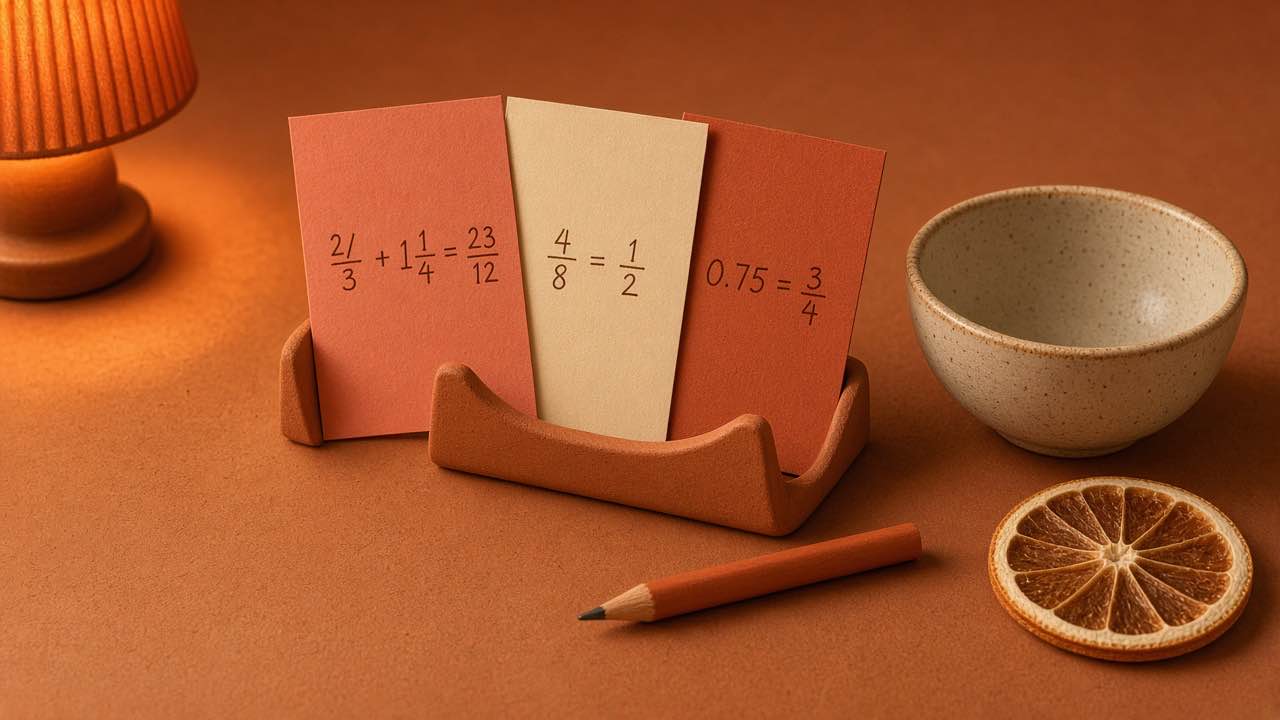
In 2026, we ran the page defaults on 10 October and left them alone. Arithmetic: 2/3 + 1 1/4 is 23/12, mixed 1 11/12, decimal 1.916666666667. Simplify: 4/8 is 1/2, GCD 4, which is 50 percent. Decimal card: 0.75 is 3/4, 75 percent. Those three lines are the samples the page restores when you hit Reset examples.
OpenStax Prealgebra 2e adds unlike denominators by rewriting both fractions over a common denominator, combining numerators, then simplifying. [1] Multiplication and division do not need that rewrite: multiply across, or multiply by the reciprocal. [2] The page uses those same products of integers, then cancels a greatest common divisor.
This is homework and kitchen arithmetic, not a grading policy, a tax worksheet, or investment advice. No affiliate relationships are disclosed because none apply.
How the three cards work
The page is three independent cards. Pick the one that matches the sentence you would write by hand.
- Open the fraction calculator in the browser.
- For two-number math, fill Fraction A and Fraction B, then pick
+,−,×, or÷. - To reduce one value, use Simplify fraction.
- To convert a terminating decimal, type it in Decimal to fraction.
- Hit Reset examples to restore
2/3,1 1/4,4/8, and0.75.
Results update as you type. There is no Calculate button on the arithmetic or simplify cards. The decimal card updates on the same input event.
| Card | Default input | Simplest result | Other forms on the page |
|---|---|---|---|
| Add | 2/3 + 1 1/4 | 23/12 | mixed 1 11/12; decimal 1.916666666667 |
| Simplify | 4/8 | 1/2 | GCD 4; decimal 0.5; 50 percent |
| Decimal | 0.75 | 3/4 | decimal echo 0.75; 75 percent |
Each card keeps its own status line. A bad denominator on the add card does not wipe a valid simplify result. That is useful when you are checking homework in pieces.
Input rules the page actually enforces
The fields look simple. The script is picky in a few places, and those rules match what we saw on 10 October 2026.
- Whole part, numerator, and denominator are separate integers. Leave the whole part at
0when you have only a proper or improper fraction. - Numerator and denominator must both be filled, or both left empty for a whole number over
1. - The numerator must be zero or positive. Put the minus sign on the whole part.
-1whole,2numerator,3denominator is-1 2/3. - Denominators must be positive integers. Zero is rejected. A negative denominator is rejected.
- Absolute values of whole parts and fraction parts stay inside nine digits. The decimal field allows at most twelve digits after the point.
- Division by a zero operand (for example
0/1as Fraction B) shows an error and clears the arithmetic results.
If a field fails those checks, the card prints a short message instead of Infinity or NaN. Fix the box. The number comes back.
Inputs never leave the browser. The site privacy policy is the same rule for every tool.
Adding 2/3 and 1 1/4
1 1/4 is the improper fraction 5/4. Unlike denominators need a common one. The script multiplies through:
2/3 + 5/4 = (2×4 + 3×5) / (3×4) = 23/12
23 and 12 share no common factor other than 1, so the reduced form stays 23/12. As a mixed number that is 1 11/12. The decimal and percent rows are display rounding of that same rational: the page shows 1.916666666667 and 191.6666666667%.
OpenStax writes the classroom version with an LCD first, then the same numerator sum. [1] The product-of-denominators form is a valid common denominator. It is not always the least one. For 2/3 and 5/4 the product 12 happens to be the LCD as well. Reduction after the sum makes the two routes match even when the product is larger than the LCD.
A mixed number is converted before any of that happens:
improper numerator = sign × (|whole| × denominator + numerator)
1 1/4 → 1 × 4 + 1 = 5 → 5/4
Keep the sign on the whole part. The page will not accept a negative numerator in the fraction stack.
The other three operations on the same defaults
Leave 2/3 and 1 1/4 in the boxes and click −, ×, or ÷. We did that after the add check. The four answers sit on one common pair of inputs, so a wrong operator is obvious.
| Operation | Setup | Unreduced | Simplest | Mixed |
|---|---|---|---|---|
| Add | 2/3 + 5/4 | 23/12 | 23/12 | 1 11/12 |
| Subtract | 2/3 − 5/4 | −7/12 | −7/12 | −7/12 |
| Multiply | 2/3 × 5/4 | 10/12 | 5/6 | 5/6 |
| Divide | 2/3 ÷ 5/4 | 8/15 | 8/15 | 8/15 |
Subtraction uses the same skeleton with a minus in the numerator step: (8 − 15) / 12 = −7/12. Multiplication is a/b × c/d = (a×c)/(b×d), then GCD. 10/12 cancels by 2 and becomes 5/6. Division multiplies by the reciprocal: 2/3 × 4/5 = 8/15. [2]
None of those four operations is a ratio split of a total. If the question is “share 120 in the ratio 2 : 3,” that job belongs on the ratio calculator. A fraction calculator will add 2/3 and 3/5. It will not invent the missing whole.
A second multiply that shows up in the tool’s own examples is 2/3 × 3/4:
(2×3) / (3×4) = 6/12 = 1/2
That is a recipe-scale check: two-thirds of a three-quarter cup is one-half cup. Enter 0, 2, 3 on the left and 0, 3, 4 on the right, then hit ×.
Simplify 4/8 and convert 0.75
4/8 shares a GCD of 4. Divide both parts:
4÷4 / 8÷4 = 1/2
The simplify card lists that GCD so you can check a factor list by hand. Decimal 0.5. Percent 50 percent. Mixed form is still 1/2 because there is no whole part left.
0.75 is 75/100. GCD 25 yields 3/4. That is 75 percent of a whole. It is a different question from “what percent is 3 of 4?” if you already think in percents. Use the percentage calculator when the answer you want is a percent, not a reduced fraction.
The decimal converter only accepts a finite string. It scales by a power of ten, then reduces.
| Typed decimal | Integer ratio before GCD | GCD | Simplest | Mixed |
|---|---|---|---|---|
0.75 | 75/100 | 25 | 3/4 | 3/4 |
0.5 | 5/10 | 5 | 1/2 | 1/2 |
1.25 | 125/100 | 25 | 5/4 | 1 1/4 |
-0.5 | −5/10 | 5 | −1/2 | −1/2 |
Repeating decimals such as 0.333… are not a supported input. If you paste 0.333 you get 333/1000, not 1/3. Close, and still a different rational. Type 1/3 on the simplify or arithmetic card when that is the number you mean.
A list of test scores that you want as a mean is the average calculator. Combining two exact fractions is this page.
Mixed numbers, improper fractions, and percents
Algebra often wants 7/4. A recipe wants 1 3/4 cups. The page prints both so you can copy the form the assignment asked for.
- Simplest fraction is the reduced improper form, or an integer when the denominator cancels to
1. - Mixed number splits off the whole part and leaves a proper remainder.
- Decimal is the same rational rounded for reading, up to twelve places.
- Percent is that rational times
100, rounded to ten places, then a%suffix.
For the default add, those four lines are 23/12, 1 11/12, 1.916666666667, and 191.6666666667%. The first two are exact. The last two are display.
| Form | What it is | Default add result |
|---|---|---|
| Improper / simplest | reduced num/den | 23/12 |
| Mixed | whole plus proper remainder | 1 11/12 |
| Decimal | display conversion | 1.916666666667 |
| Percent | same rational × 100 | 191.6666666667% |
If the remainder is zero, the mixed card shows only the whole number. 2/1 after reduction is 2, not 2 0/1. Zero itself displays as 0.
Common mistakes we keep seeing
These are the errors the status line is built to catch, plus the ones it cannot catch because the arithmetic is still “valid.”
Adding tops and bottoms.
2/3 + 1/4is not3/7. You only add numerators after the denominators match.Skipping the mixed-to-improper step.
1 1/4is5/4, not1/4. Leaving the1off the second operand changes the default add from23/12to11/12.Putting the minus on the numerator. The page rejects a negative numerator. Use the whole-part sign.
Treating two cuts as one sum. A 20 percent markdown and then another 20 percent markdown is not the same as adding
1/5 + 1/5of the original price. The second cut uses a new base.Asking this page to split a total.
2 : 3of one whole is a ratio problem.Pasting a repeating decimal and expecting
1/3. Finite input stays finite.Reading the percent row as a grade.
23/12as a percent is about191.67 percentof a whole. That is larger than 100 percent because the sum is larger than1. It is not a test score.
The first one is the FAQ below. The rest are just easy to type when you are tired.
Where this page stops
It will not solve an equation for x. It will not stack a checkout discount. It will not apply a syllabus weight. Whole parts, numerators, and denominators are integers of at most nine digits. Decimal and percent lines round for reading. The simplest-fraction line is the exact rational.
The arithmetic card takes two operands. For three fractions, multiply or add the first pair, copy the reduced result, then combine the third by hand in a new run. The page will not keep a running tape.
Published 10 October 2026; revised on the same day after we re-checked the defaults and the three other operators on the same sample pair.
Does the calculator send my numbers anywhere?
No. The fields stay in the current browser session. Close the tab or reset examples if someone else uses the same device.
Why is 2/3 + 1 1/4 equal to 23/12, not 3/7?
Adding numerators and adding denominators (2+1 over 3+4) is not fraction addition. It looks neat. It is wrong. You only add numerators after the denominators match. 2/3 + 5/4 is 8/12 + 15/12 = 23/12.
Can I enter a repeating decimal?
Not as a repeating bar. Type a finite decimal, or enter the fraction you already know (1/3) on the arithmetic or simplify card.
Why do I see both 23/12 and 1 11/12?
They are the same number. 23 ÷ 12 is 1 with remainder 11, so 1 11/12. Algebra keys often want the improper form. A measuring cup wants the mixed form. Copy the one your sheet asked for.
What happens if I divide by zero?
The second operand cannot be the number zero. 2/3 ÷ 0/1 is undefined. The card shows an error and clears the four result lines until you change Fraction B. A zero denominator on either fraction is also blocked, because that is not a rational number.
Can I multiply more than two fractions at once?
No. Two operands, one operator. Reduce the first product, then use that result as the next left-hand side.
What to do next
Open the fraction calculator, leave the samples, and confirm 23/12, 1/2, and 3/4 before you trust a hand common denominator. Then click −, ×, and ÷ on the same pair if you want the four-row table above to appear on your screen. If the next question is a percent of a base, switch pages rather than converting back and forth by habit.